

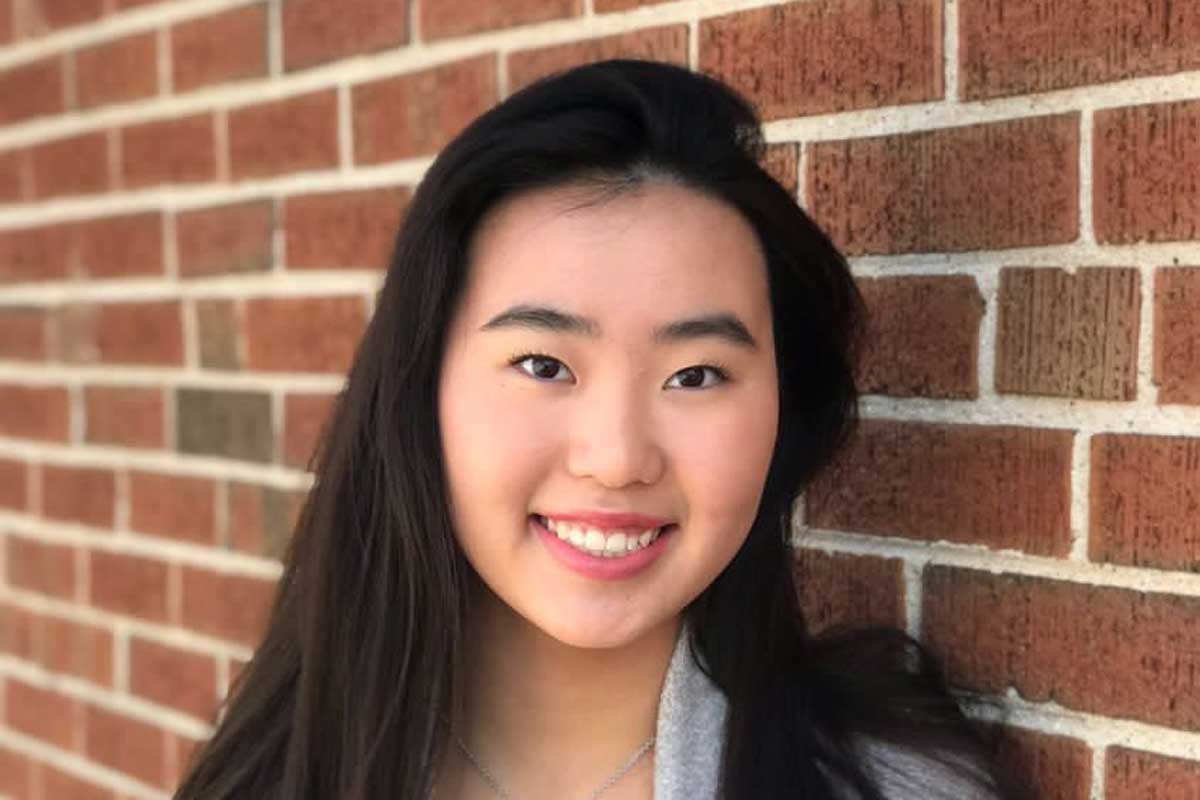
This post was written by Mallika Sunder, a member of the Wellesley College Class of 2027 who worked with Associate Research Scientist Kate Price, Ph.D., through the Class of 1967 Internship Program.
Content warning: This post discusses child sex trafficking.
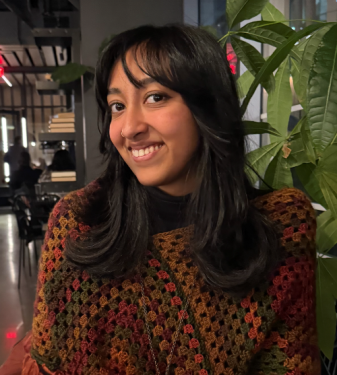 In September 2025, I began working with Associate Research Scientist Kate Price, Ph.D., on a project tracking how different state statutes across the U.S. treat child victims of sexual trafficking. Before joining this project, I had some exposure to human trafficking issues from a past internship with a human trafficking law firm, but after a couple months working under Dr. Price, I quickly realized I had so much more to learn.
I was shocked to discover that children who are sexually trafficked within states may be arrested under state prostitution laws. In 35 states in the U.S., a child can be criminalized for their own maltreatment. I also learned through past human trafficking research that this criminalization may happen when our society views sexually trafficked children as delinquents rather than as victims. Public perception of human trafficking victims plays a role in whether a child gets arrested or whether they get mental health and job support instead. Noncriminalization laws, which do not allow states to arrest children under 18 for prostitution, benefit these children the most.
With Dr. Price’s guidance, I embarked on a research project to test whether public awareness of human trafficking issues has an effect on the passage of anti-criminalization laws for children who have been sexually trafficked. Eventually, I found that there is an increase in Google searches related to human trafficking in a state about three years before noncriminalization legislation is passed in that state.
Through this project, I had to read various juvenile, prostitution, and human trafficking state laws to determine how a state treats sexually trafficked minors. I gained valuable skills in interpreting legal documents, and got to use my quantitative data analysis skills to test whether awareness of human trafficking issues may be associated with the passage of a state’s noncriminalization legislation. Eventually, I got to present this research at Wellesley’s annual Ruhlman conference, which was one of the highlights of this internship. I also co-authored with Dr. Price an article for The Conversation: How the law can add to child sex trafficking victims’ existing trauma.
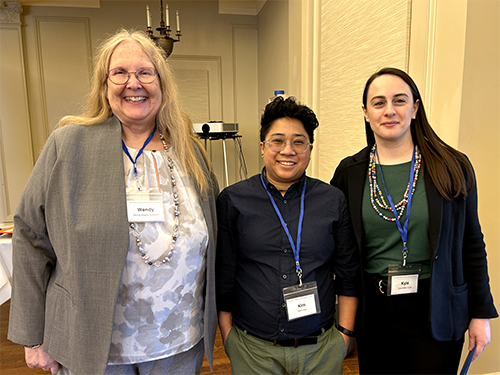
Another highlight of working with Dr. Price was participating in a symposium in March about familial commercial sexual exploitation of children (CSEC), sponsored by the Wagner Centers for Wellesley in the World, where I got to meet researchers, nonprofit directors, and advocates doing amazing work to prevent human trafficking. Many of the people who attended had CSEC lived experience, which means that they had gained expertise about human trafficking issues through their personal experiences with familial and non-familial CSEC. Getting to learn from these experts about how the law can better prevent human trafficking was such a valuable experience. It was inspiring to meet so many influential anti-human trafficking advocates at once.
I have felt supported and encouraged by Dr. Price throughout this internship. I have become immersed in the world of human trafficking research and advocacy, and I am more than excited to come back to WCW next year and work more with Dr. Price on her research. This research experience has taught me to embrace new experiences and perspectives, to always look out for those ignored by our legal system, and to make use of the amazing mentorship opportunities that WCW provides.
Mallika Sunder is a member of the Wellesley College Class of 2027 who is majoring in political science and minoring in economics.
Content warning: This post discusses child sex trafficking.
In September 2025, I began working with Associate Research Scientist Kate Price, Ph.D., on a project tracking how different state statutes across the U.S. treat child victims of sexual trafficking. Before joining this project, I had some exposure to human trafficking issues from a past internship with a human trafficking law firm, but after a couple months working under Dr. Price, I quickly realized I had so much more to learn. I was shocked to discover that children who are sexually trafficked within states may be arrested under state prostitution laws. In 35 states in the U.S., a child can be criminalized for their own maltreatment. I also learned through past human trafficking research that this criminalization may happen when our society views sexually trafficked children as delinquents rather than as victims. Public perception of human trafficking victims plays a role in whether a child gets arrested or whether they get mental health and job support instead. Noncriminalization laws, which do not allow states to arrest children under 18 for prostitution, benefit these children the most.
With Dr. Price’s guidance, I embarked on a research project to test whether public awareness of human trafficking issues has an effect on the passage of anti-criminalization laws for children who have been sexually trafficked. Eventually, I found that there is an increase in Google searches related to human trafficking in a state about three years before noncriminalization legislation is passed in that state.
Through this project, I had to read various juvenile, prostitution, and human trafficking state laws to determine how a state treats sexually trafficked minors. I gained valuable skills in interpreting legal documents, and got to use my quantitative data analysis skills to test whether awareness of human trafficking issues may be associated with the passage of a state’s noncriminalization legislation. Eventually, I got to present this research at Wellesley’s annual Ruhlman conference, which was one of the highlights of this internship. I also co-authored with Dr. Price an article for The Conversation: How the law can add to child sex trafficking victims’ existing trauma.
Another highlight of working with Dr. Price was participating in a symposium in March about familial commercial sexual exploitation of children (CSEC), sponsored by the Wagner Centers for Wellesley in the World, where I got to meet researchers, nonprofit directors, and advocates doing amazing work to prevent human trafficking. Many of the people who attended had CSEC lived experience, which means that they had gained expertise about human trafficking issues through their personal experiences with familial and non-familial CSEC. Getting to learn from these experts about how the law can better prevent human trafficking was such a valuable experience. It was inspiring to meet so many influential anti-human trafficking advocates at once.
I have felt supported and encouraged by Dr. Price throughout this internship. I have become immersed in the world of human trafficking research and advocacy, and I am more than excited to come back to WCW next year and work more with Dr. Price on her research. This research experience has taught me to embrace new experiences and perspectives, to always look out for those ignored by our legal system, and to make use of the amazing mentorship opportunities that WCW provides.
Mallika Sunder is a member of the Wellesley College Class of 2027 who is majoring in political science and minoring in economics.
1366 Hits
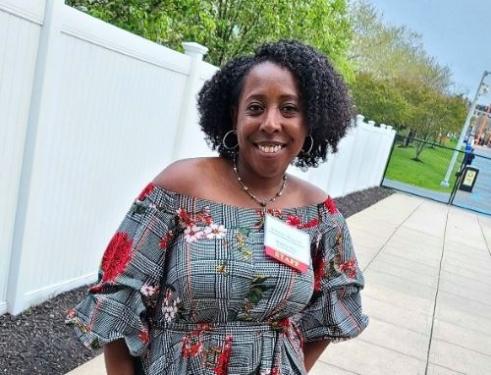 Early childhood education isn’t just a job for me—it’s been my life’s work for over 20 years. I began in this field as an infant teacher, and those early years in the classroom shaped my understanding of what high-quality early learning can truly look like. That time in the classroom also sparked a deeper commitment: to support educators themselves so they can uplift children and families every day.
 As Massachusetts reels from
  The technological world is all around us and developing at a speed that is impossible to keep up with. Adolescents are now more connected to technology than ever before and face both opportunities and obstacles online. Learning to use technology is similar to learning how to drive a car; there are risks involved, and drivers need to learn certain rules and receive gentle guidance before driving on their own. Parents in both scenarios should be in the passenger seat next to their child: setting boundaries, but giving their child the autonomy to eventually thrive on their own. It’s easy to be afraid of the unknown in the digital world, but parental involvement is essential.
 As Father’s Day approaches, many of us are thinking about the role that fathers play in our lives—whether they are our own fathers, our spouses, our relatives, our children. I spend more time than the average person thinking about the role that fathers play. Specifically, I study the conversations they have (or in many cases, don’t have) with their teenage children about sex and relationships, and the effects these conversations have on their teens’ health.

 What better place to foster a love of reading and engage children in a variety of literacy activities than in out-of-school time (OST) programs? Research shows that OST programs can support the development of and excitement about literacy in a setting where children feel comfortable.
 Beginning in the mid-1990s, with my colleague, Benjamin E. Saunders, Ph.D., of the Medical University of South Carolina, and a team of researchers, I conducted an
  Last year, the U.S. Surgeon General
 With a collection of government stamps in hand, I now needed to secure the tribal backing for the project. Government approval merely made my NGO official, but without the tribal endorsement, my effort to educate girls would be just another import with a short shelf life.
 Dear Friends of WCW:

 Below is an excerpt by Betsy Nordell, Ed.D., a NIOST master observer, from the book











 Nearly


 , Ph.D., is a research scientist at the Wellesley Centers for Women studying




 Critical race theory has become the latest front in the culture wars. Depending on what you’ve read or what you’ve heard from politicians, you may be under the impression that critical race theory means talking about racism in any context, or that it means white people are inherently racist.
 Senior Research Scientist
 May is Mental Health Awareness Month. This year, it comes at a time when we have an increased focus on mental health due to the COVID-19 pandemic. Media reports have focused on the
 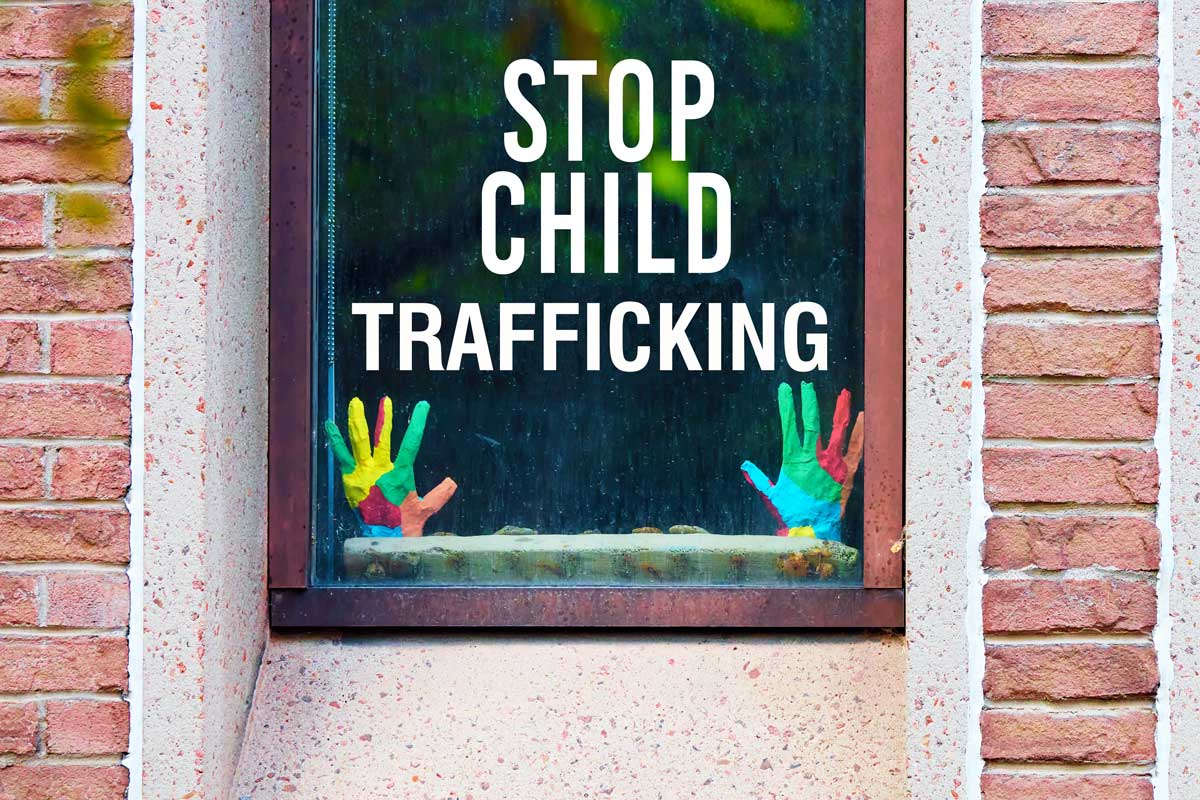 April is Sexual Assault Awareness Month and Child Abuse Prevention Month. Over the years, our work at WCW has addressed a wide range of critical issues related to these topics. One of the lesser publicly understood issues is the pressing problem of commercial sexual exploitation of children (CSEC) and teens, also known as sex trafficking.
 On March 11, 2021, the House of Representatives passed a bill seeking to “create a special education scheme to support deserving students attending public tertiary institutions across Liberia. The Bill is titled “An Act to Create a Special Education Fund to Support and Sustain the Tuition Free Scheme for the University of Liberia, All Public Universities and Colleges’ Program and the Free WASSCE fess for Ninth and Twelfth Graders in Liberia, or the Weah Education Fund (WEF) for short. The bill when enacted into law, will make all public colleges and universities “tuition-free”. The passage of this bill by the Lower House has been met by mixed reactions across the country: young, old, educated, not educated, stakeholders, parents, teachers among others, have all voiced their opinions about this bill. While some are celebrating this purported huge milestone in the education sector, others are still skeptical that this bill may only increase access but not address the structural challenges within the sector. I join forces with the latter, and in this article, I discuss the quality and access concept in our education sector and why quality is important than access. I recommend urgent action to improve quality for learners in K-12.

 As a new mother, you hold your baby in your arms, wishing for the best of the best for her. You may also be facing difficult career questions upon her arrival: When should you start working again? Should you be a stay-at-home-mom? Should you get a new job with a more flexible schedule? Will you be able to get promoted when you’re back at work? If you have a daughter, will she face the same choices in the future?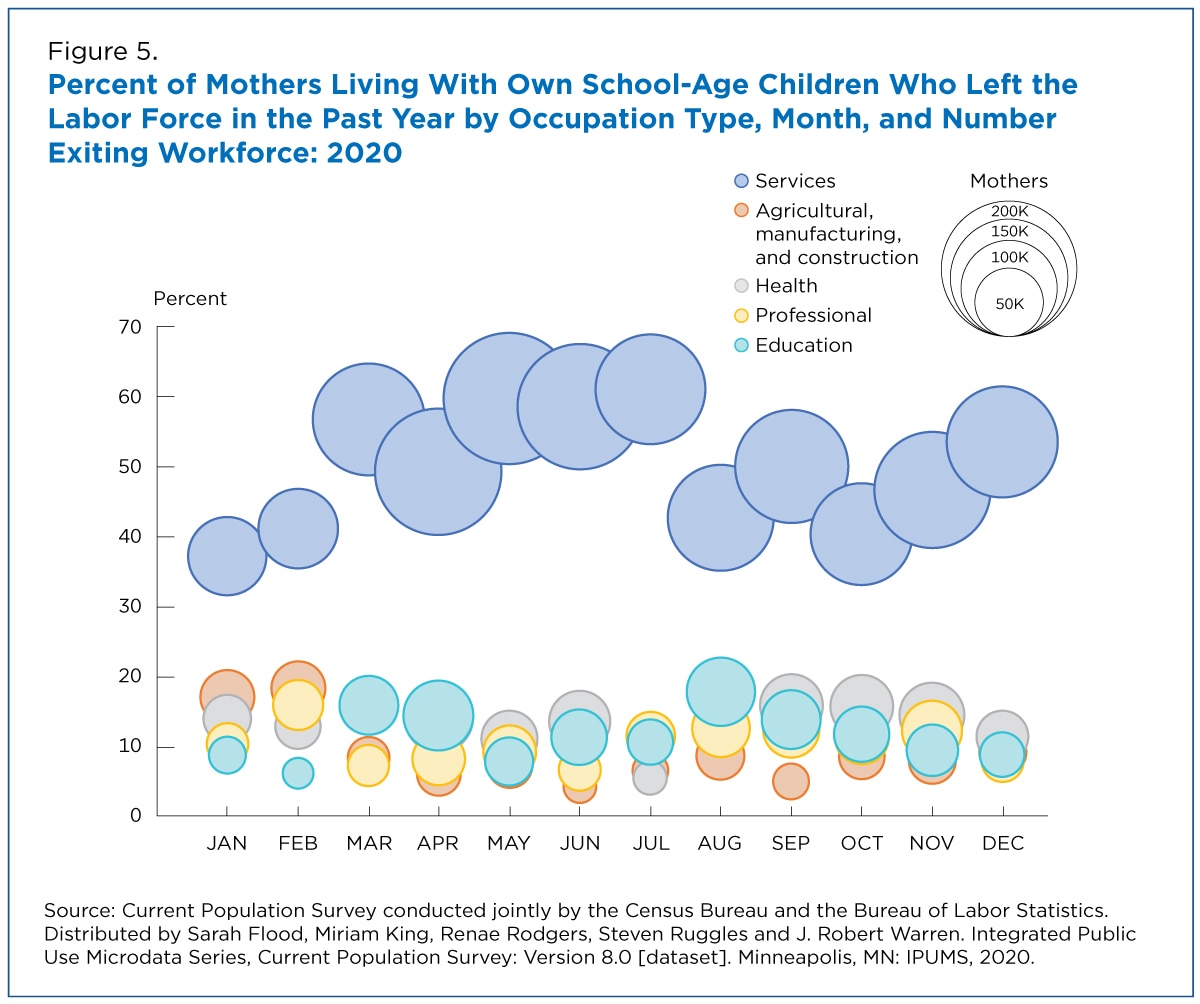
 Sex education in the American public school system varies from state to state and from school district to school district. The lack of standardized sex education makes family education and conversations about sex and relationships all the more important for teenagers and their development. It is often assumed that parents are the default—that they are the only family members responsible for initiating these conversations. In my research conducted with WCW Senior Research Scientist
