


 When I first came across Emily Style’s words, “A good curriculum is both a window and a mirror,” I began realizing what had been missing in my education at an English language immersion high school in Turkey.
We started with English as a second language material developed by our teachers, but by the middle of seventh grade we knew enough English to be assigned readers that had been used some years back in elementary schools in the U.S. These books had numbers on them such as 3-2 or 4-3, which I later surmised referred to grade and semester levels in elementary schools. One story we read in such a reader has stayed with me all these years. It was about a little girl from New England whose family had moved to an arid town in the Southwest. She was upset that there were no evergreen trees that could be cut to decorate a Christmas tree for the coming holiday. In the story she used her ingenuity to pick a prickly bush that grew in the desert and decorated it with tinsel and ornaments. Happy ending.
The story opened a number of windows for me, a Muslim teenager growing up in a lush Mediterranean climate. Start with Christmas, the need for an evergreen tree, prickly bush growing in a desert, a little girl’s agency to find a tree to decorate, on and on.
What I realized when I read Emily’s work was that my English curriculum had indeed broadened my vision but it did not have mirrors for me to see myself reflected. This realization helped me discover why my learning stood a little bit away from who I was deep inside. It had nurtured an “other” in me that was open to new ideas and knowledge but was not fully integrated with who I truly was, in a way that was satisfying nor authentic. Recognizing the source of the problem was important for me bridge that divide.
Many years later when my colleague Ineke Ceder and I were reporting our findings on the scarcity of women and people of color leading large theaters in the U.S., we advocated for an industry-wide shift in who holds power so that theater programming can more widely incorporate the voices of wider segment of humanity. We wrote, “the function of theater is not only to hold a mirror to the varieties of human conditions, but also challenge it and bring fresh perspectives. In the words of a visionary educator, Emily Style (2014), good theater, just like a good curriculum, must both hold a mirror to and open windows for new ideas.”
Erkut, S. & Ceder, I. (2016). Women’s leadership in residential theaters: Final report. Wellesley Centers for Women. p. 106.
Style, Emily. "Curriculum as Window and Mirror," Listening for All Voices,OakKnoll School monograph. Summit, NJ, 1988.
Sumru Erkut, Ph.D., currently a senior scholar at the Wellesley Centers for Women (WCW), was a WCW senior research scientist and associate director. Her research interests include women’s leadership, racial/cultural norms and identity in youth and families, and adolescent development.
 In a meeting with the Congressional Black Caucus earlier in October, Facebook’s Chief Operating Officer,
  My colleagues Vicki Kramer, Allison Konrad, and I interviewed 50 women directors, 12 CEOs (nine male), and seven corporate secretaries at Fortune 1000 companies. We found that

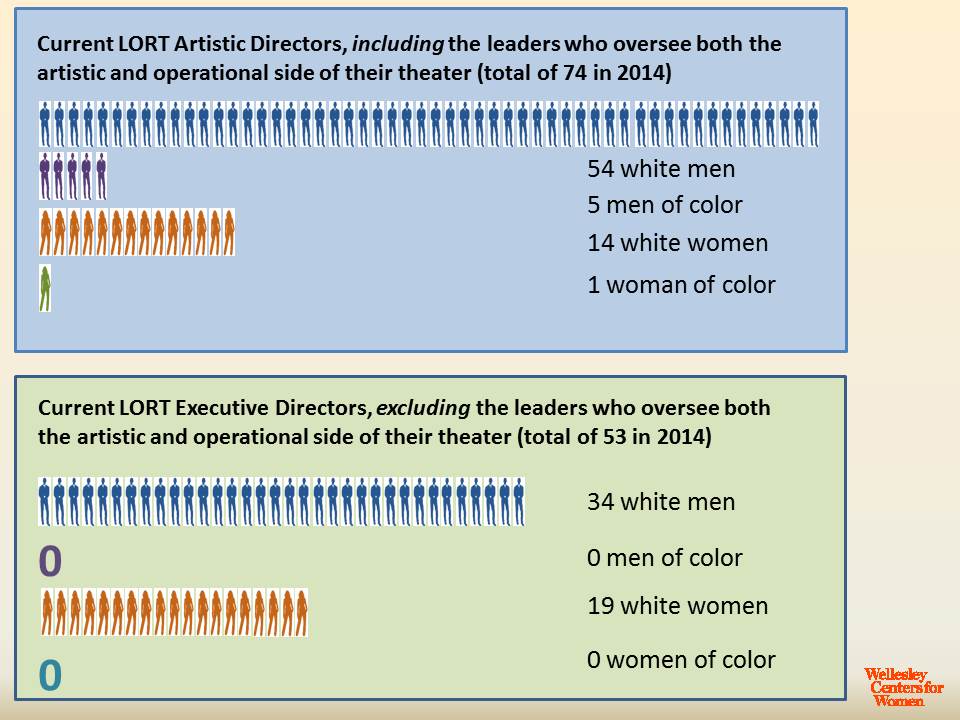
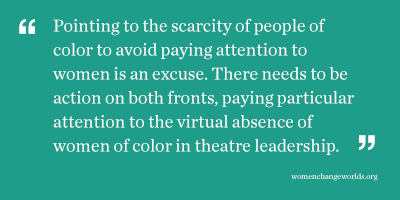 A word of caution: To conclude that the main problem is a pipeline issue and over time more women and people of color will become viable candidates is an incomplete diagnosis of the problem, and an excuse. It dismisses the large numbers of producers and directors who are well prepared and eager to take on artistic director positions. In addition to the pipeline, there is just as profound a glass ceiling that can be broken with a change in mindset among those who make hiring decisions. Here are some action points for hiring committees about selecting ADs:
 But how do recruiters on the front-end value a varsity credential? Does sports participation in college, for example, offer access to enter a corporate career?

 members of Twitter’s board members have undergraduate degrees from liberal arts colleges: one has a degree in English; another in Asian Studies. Couldn’t female experts in entrepreneurial management, intellectual property law, investment management contribute, for example, contribute positively within such a governance structure? It was smart of Twitter to include diversity of educational and work experiences on its board. Twitter (and all corporations) needs to stop making excuses and go for greater diversity, by including female, minority, and international members on its board.
 My colleagues and I interviewed 50 same-sex couples in Massachusetts and their children. Some of the couples had chosen to get married and some had not. Whether or not a given couple chose to marry, they talked about the importance of the legitimacy and the recognition the change in the law offered them. Their sense was that when legal marriage is available to same-sex couples, the ramifications stretch far beyond the couples themselves. Perceptions of families, co-workers, neighbors, and strangers shift toward greater acceptance.
 by people who do not know the candidate personally. When there is no familiarity with the person being evaluated to trump the bias that makes men seem more competent, men are chosen over equally competent women.
