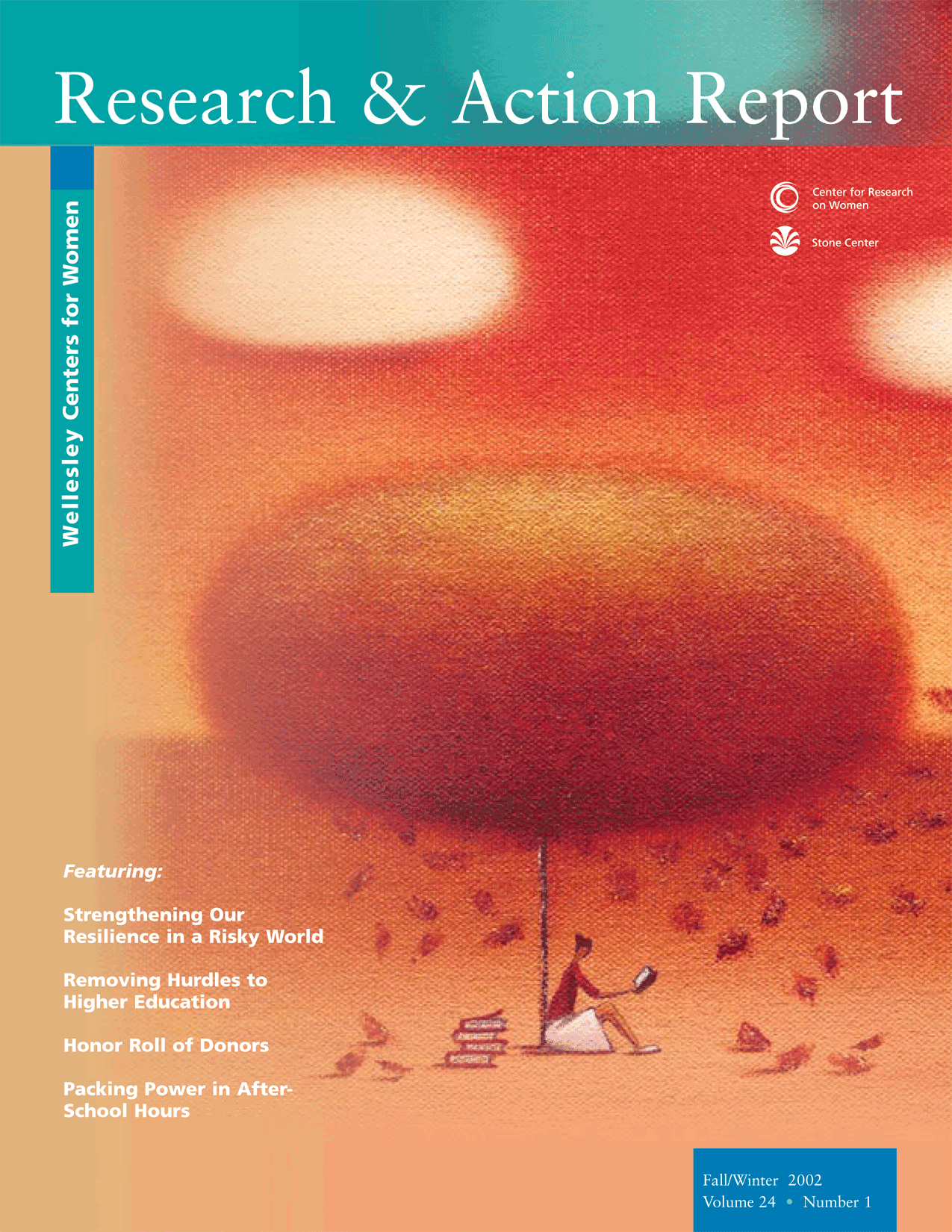
Research & Action Report Fall/Winter 2002
by Linda Hartling
Over the last year we have faced monumental adversity — a devastating national tragedy, ongoing concerns about terrorism, unpredictable international conflict, a serious downturn in the economy, as well as many other hardships related to these traumatic circumstances. These adversities are testing the courage and fortitude of individuals, families, and communities throughout our country and around the world. In response, many researchers and clinicians have renewed or expanded their efforts to understand how people overcome trauma, severe hardships, and adverse conditions — that is, they have been studying resilience.
In the past, many researchers have focused on identifying individual traits associated with resilience, which is generally defined as the ability to achieve positive outcomes after experiencing extreme difficulties. These traits include intelligence, a "good-natured" temperament, competence, internal locus of control, self-esteem, etc. Moving beyond this approach, in 1992 Judith Jordan, co-director of the Jean Baker Miller Training Institute (JBMTI), wrote a groundbreaking paper reconceptualizing the notion of resilience. Integrating her understanding of relational development and her work with trauma survivors, Jordan proposed that "we can no longer look only at factors within the individual which facilitate adjustment; we must examine the relational dynamics which encourage the capacity for connection." She emphasized that "Few studies have delineated the complex factors involved in those relationships which not only protect us from stress but promote positive and creative growth."
Expanding on Jordan's observations, the JBMTI faculty engaged in an intensive examination of resilience at the 2000 Summer Training Institute. The discussion began with a review of the research and literature that suggests that resilience and the individual characteristics associated with resilience are most often developed in a context of encouraging relationships. Daniel Siegle (1999), for example, states that interpersonal relationships are the central source of experiences that influence how intelligence develops, which contributes to one's ability to be resilient. "Human connections create neuronal connections," he writes. Other researchers have demonstrated that a child's closeness to his or her "mother was found to correlate most significantly with a child's self-esteem" (Burnett & Demnar, 1996).
In a national longitudinal study of over 12,000 adolescents, Michael Resnick and his colleagues (1997) determined that "parent-family connectedness and perceived school connectedness" reduced children's risk of emotional distress, early sexual activity, substance abuse, violence, and suicidal behavior. Renée Spencer's paper (2000) documented numerous studies indicating that a relationship with one supportive adult is associated with good outcomes for children coping with poverty, maltreatment, separation from a parent, marital discord in the home, divorcing parents, and parental mental illness.
Inspired by more and more research suggesting that growth-fostering relationships promote healthy responses to adverse experiences, the JBMTI faculty has begun to explore a broader view of resilience: relational-cultural resilience. From this perspective, JBMTI scholars are examining the specific qualities of relationships that help people overcome overwhelming events, qualities that include mutual empathy, mutual empowerment, mutuality, authenticity, attunement, and responsiveness. Furthermore, they propose that our understanding of resilience can be dramatically enriched by investigating the resilience of individuals who have been systematically marginalized and devalued by the dominant culture—individuals who have experienced traumatic disconnections inflicted on them because of their race, sex, sexual orientation, social class, or mental or physical disabilities. Often these individuals have had to exercise extraordinary resilience to accomplish ordinary tasks (Genero, 1995). For instance, Elizabeth Sparks (1998), in her paper challenging the commonly held myths about African American mothers on welfare, describes how the mothers in her study used connection, collaboration, and community action to foster resilience in the face of paralyzing economic hardships and relentless discrimination.
The JBMTI faculty is continuing to explore relational- cultural resilience through various research and action projects. Renée Spencer, Judith Jordan, and Jenny Sazama (2002) have developed a preliminary report describing their findings from a set of focus groups conducted with children and adolescents about their relationships with adults. The purpose of the study, supported by the Robert S. and Grace W. Stone Empowering Children for Life Primary Prevention Initiatives, was to listen directly to the voices of youth from a variety of different cultural backgrounds and experience. These young people expressed their desire for strong relationships with adults and also described some of the barriers that prevent these relationships from developing. In another effort early this November, JBMTI faculty members invited community members to a workshop entitled "Raising Resilient Children in a Risky World: Prevention through Connection." This collaborative workshop explored the protective qualities of relationships during infancy, early childhood, the turbulent years of adolescence, and during times when young people are particularly susceptible to high-risk behaviors such as eating disorders, substance abuse, and aggression.
When faced with trauma or hardships, Judith Jordan (1992) reminds us that relationships provide a "life-giving empathic bridge" that allows individuals to move out of devastation and isolation toward resilience. Clearly, this was demonstrated in the groundswell of national support extended to individuals, families, and communities directly affected by the September 11th tragedy. Ultimately, in the wake of heartache and uncertainty, interpersonal acts of compassion affirm that our courage grows through connection and our resilience grows through relationships.
Six Relational Ways to Strengthen Resilience in Ourselves and Others
- Find and participate in mutually empathic, responsive relationships and/or help others find and participate in these types of relationships.
- Listen and respond to others who are struggling and/or find someone who can compassionately and resourcefully listen to your struggles.
- Find models of effective, resourceful responses to adversity and/or become a model.
- Find a mentor and/or become a mentor.
- Expand your relational competence and/or help others expand their competence by assisting others or contributing to the community.
- Utilize, and/or help others utilize, services that provide professional or relational support, e.g., psychotherapy, social services, mutual support groups, church/community groups, etc.
References
Burnett, P. C., & Demnar, W. J. (1996). The relationship between closeness to significant others and self-esteem. Journal of Family
Studies, 2(2), 121-129.
Genero, N. (1995). Culture, resiliency, and mutual psychological development. In H. I. McCubbin, E. A. Thompson, A. I. Thompson, & J. A. Futrell (Eds.), Resiliency in ethnic minority families: African-American families (pp. 1-18). Madison, WI: University of Wisconsin.
Jordan, J. V. (1992). Relational Resilience. Work in Progress, No. 57.
Wellesley, MA, Stone Center Working Paper Series.
Resnick, M. D., Bearman, P. S., Blum, R. W., Bauman, K. E., Harris, K. M., Jones, J. , Tabor, J., Beuhring, T., Sieving, R. E., Shew, M., Ireland, M., Bearinger, L. H., & Udry, R. (1997). Protecting adolescents from harm: Findings from the national longitudinal study on adolescent health. Journal of the American Medical Association, 278(10), 823-832.
Siegle, D. J. (1999). The developing mind: Toward a neurobiology of
interpersonal experience. New York: Guilford Press.
Sparks, E. (1998). Against all odds: Resistance and resilience in African
American welfare mothers. Work in Progress, No. 81. Wellesley, MA: Stone Center Working Paper Series.
Spencer, R. (2000). A comparison of relational psychologies. Project Report, No. 5. Wellesley, MA: Stone Center Working Paper Series.
Spencer, R., Jordan, J. V., & Sazama, J. (2002). Empowering children for life: A preliminary report from the Robert S. and Grace W. Stone Primary Prevention Initiatives. Project Report, No. 9. Wellesley, MA: Stone Center Working Papers Series.
Summer Training Institute (2000). Relational-Cultural Resilience. Annual
conference sponsored by the Jean Baker Miller Training Institute at
Wellesley College, Wellesley, MA.
Linda Hartling, Ph.D., is associate director of the Stone Center's Jean Baker Miller Training Institute.