
Research & Action Report, Spring/Summer 2011
by Rangita de Silva-de Alwis, S.J.D.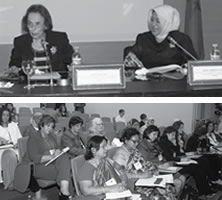
Rangita de Silva-de Alwis, S.J.D., the director of international human rights policy programs at the Wellesley Centers for Women (WCW), partnered with the Moroccan Ministry of the Interior, The Kingdom of Morocco, to present a seminal program, “Rabat Roundtable: Women Leading Change in the Muslim World,” May 16–17, 2011, in Rabat, Morocco. This critical Roundtable was originally organized in partnership with the Hon. Dr. Moushira Khattab, the former Minister for Family and Population of Egypt, to be held in Cairo under the auspices of the Ministry of Family and Population, Egypt with whom de Silva-de Alwis has partnered with in her work with the Legislative Reform Initiative along with UNICEF. The political changes sweeping Egypt and other countries propelled WCW and its partners to seize the transformative potential of these historic movements and to reconvene the program in Rabat this May. The Roundtable brought together leading women’s rights advocates from the Muslim World for high-level discussion and debate to ensure that women are part of the important reformist and decision making processes. Over two dozen local, women government officials from Morocco joined the Roundtable initiating a global-to-local exchange.
Research & Action Report, Spring/Summer 2011 In February, Rangita de Silva-de Alwis, S.J.D. served as a panelist on the program, “Expanding Access to Education and Employment Opportunities for Girls and Women with Disabilities in Science, Technology, Engineering and Math (STEM) —Strategy for Action!” during the United Nations Commission on the Status of Women meetings in New York, NY. Her presentation was on “STEM: Expanding opportunities for women and girls with disabilities in education and employment.” Also in February, de Silvade Alwis presented her paper, “Examining Gender Stereotypes in New Work/ Family Reconciliation Policies,” accepted for publishing in the Duke Journal of Gender Law & Policy, during the Duke University Law School spring symposium.
Research & Action Report, Spring/Summer 2011
Sari Pekala Kerr, Ph.D., who arrived at the Wellesley Centers for Women (WCW) in 2010, brings not only experience in economic research and consulting in the U.S. to her work at WCW, but also expertise in analyzing economic effects of government policies in her homeland of Finland. That expertise became possible because of Finland’s remarkable record of demographic statistics, which reflect—in a breadth of detail that can amaze many—the experience of three generations of Finns. The Centers expect many of Kerr’s contributions to benefit from that research. Her newest project—supported by the Centers’ 35th Anniversary Fund—will study how maternity leave policies in both Finland and the United States affect women’s subsequent employment.
Research & Action Report, Spring/Summer 2011
by Peggy McIntosh, Ph.D.
U.S. education is in trouble . Many types of school reform have been proposed and tried, but most are not working. They are not creating real solutions to problems. I believe that education reform will continue to falter unless it treats teachers as whole human beings, not as neutral pass-throughs, or as failing parts of machinery. Too often teachers are punished, disrespected, and excluded from conversations on what might actually make education successful for all of our students. What teachers know, what they can contribute, is left out of most efforts to reform education. We cannot change our schools, our systems, without respecting the deep experience of teachers.
Research & Action Report, Spring/Summer 2011 Last year, Boston Public Schools Superintendent Carol Johnson identified 14 “Turnaround Schools,” described as significantly underperforming and in need of monitoring, support, and reform. Twelve of these schools were also designated by the Massachusetts Department of Elementary and Secondary Education as “Level 4” schools: those with consistently low scores and no substantial improvement over a four-year period in both English/ Language Arts and Mathematics on the Massachusetts Comprehensive Assessment System (MCAS).
In this issue:
 | Wellesley Centers for Women 781.283.2500 |
Copyright © 2026 Wellesley Centers for Women, Wellesley College | Privacy Policy
